
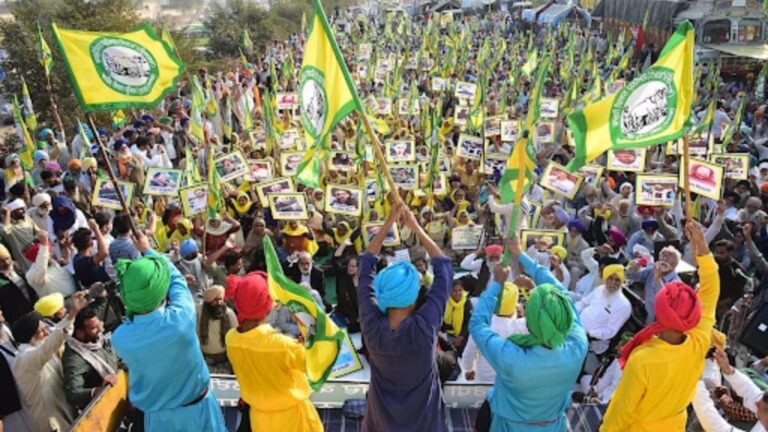
Since November 2020, thousands of Indian farmers protested on the streets of New Delhi against Prime Minister Modi's agricultural reforms. Despite the fact that the government opposes international interference, this seemingly local matter has international consequences.
Since November, thousands of farmers have encamped outside the Indian capital of New Delhi, as a sign of protest against Prime Minister Modi's reforms on farming laws. The reforms include the removal of guaranteed minimum prices for agricultural products, with the purpose of further liberalizing the country's economy. While farmers claim that removal of state protection will open the doors to large private investors that will decrease the prices of local products, Modi advocates that it will support the country's economy.
As international celebrities like Greta Thunberg or Rihanna manifested their support for the farmers, the Indian government accused them of promoting "neither accurate nor responsible”Information and warned that the country will not tolerate any kind of international interference in Indian affairs. Although this has become a matter of sovereignty to Modi, the ongoing demonstrations will, in the long run, impact the rest of the world.
It Will Affect Supermarkets and Clothing Stores
India is the world's largest producer, consumer and exporter of spices. According to the Indian Ministry of Commerce and Industry, the country is responsible for 68 percent of the spices on the world market. These range from pepper, chili, ginger, turmeric, coriander, cumin, garlic, curry powder and fennel, to the cardamom essential for Swedish cinnamon buns. On top of that, India ranks as the second largest producer of rice, wheat, cereals, fruits and vegetables behind China, and the world's largest milk producer. according to India's Agricultural & Processed Food Products Export Development Authority.
Most of these products come from the states of Punjab, Haryana and Delhi, where the protests are taking place. As the farmers advocate that they will not stop protesting until Modi changes his mind, supermarkets around the world will have to find alternative producers to fulfill the demand of their customers.
All the more, according to the United States Department of Agriculture, 40 percent of the world's cotton comes from India. This means that the probability of possessing a piece of clothing “made in India” is rather high. However, a cotton deficit will have the effect of increasing its price, and with it the one of its derivative products. Therefore, this protest that is taking place on the other side of the world may have heavy consequences on the cost of many clothing items sold in Europe.
In a globalized economy, strikes in the agricultural sector abroad can therefore have major impacts on a global scale. Although Modi wishes that the farmers' protest remains an internal issue, its impact will be felt all over the world, from Sweden to China.