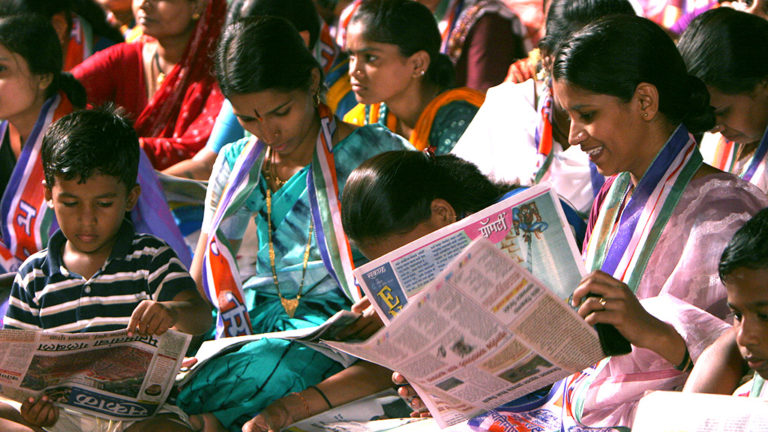
Saturday, September 8, celebrates International Literacy Day worldwide. Illiteracy is one of the main causes of poverty. Despite this, Swedish development assistance fails to focus on illiteracy, writes the organization ALEF.
Literacy is a fundamental human right. Yet, according to Unesco, there are still 750 million young people and adults who have not been taught to read and write. Most of them belong to the 800 million people still living in extreme poverty.
Two thirds of the world's illiterates are women. In sub-Saharan Africa, more than 100 million girls and women have not been allowed to go to school. India has 250 million illiterates (20 percent of the population). In the following 19 countries, according to Unesco, over 50% are illiterate: Afghanistan, Benin, Burkina Faso, Central African Republic, Chad, Ivory Coast, Ethiopia, Gambia, Guinea, Guinea-Bissau, Haiti, Iraq, Liberia, Mali, Mauritania, Niger , Senegal, Sierra Leone and South Sudan.
People who lack basic knowledge in reading, writing and arithmetic are limited in their everyday lives. They are often excluded from democratic processes, unable to access written public information or make their voices heard. They can not fully take control of their own finances, and have difficulty following up their children's schooling.
The world's largest untapped resource
These 750 million illiterates can be seen as the world's largest untapped resource. All of these talented and healthy people are prevented from living up to their potential, participating in business, civil society and societal functions, accessing written information, defending their rights and expressing their thoughts and ideas in writing.
Although literacy is a fundamental human right and a prerequisite for development, a negligible part of the total aid in the world goes to public education for illiterate adults. Sweden has a long and proud tradition of folkbildning, not least through our many movement-run folk high schools, which since the middle of the 1800th century have given young people and adults a second chance to obtain education and training. Nevertheless, Swedish development assistance does not contribute much to this key activity in poverty reduction either.
A weakness in Swedish development assistance
The criteria for being able to receive Sida grants via a framework organization are designed so that this type of program is difficult to fit into. They lump together non-formal adult education with schools for children, and believe that these are services that should be run by the state. In fact, many states in sub-Saharan Africa have explicitly left it to civil society to be responsible for educating adult illiterates. Even in Sweden, folkbildning has traditionally been run by civil society, not by the state.
We perceive this as a weakness in Swedish development aid policy. Folkbildning for adult women who lack adequate schooling should be a specialty in Swedish development assistance, not something that is an exception in the country that boasts of its feminist foreign policy. We therefore urge our decision-makers to put basic adult education on the agenda for Swedish development assistance. 750 million people must have access to the basic skills that give them the tools to participate in society on equal terms and take control of their finances and their children's future.
The International Literacy Day
September 8 every year is International Literacy Day. The day was established in 1966 by Unesco to draw attention to the importance of literacy as a prerequisite for eradicating poverty, achieving equality and creating sustainable, prosperous and peaceful societies.