
On April 25, 2015, life changed completely for many people in Nepal. The earthquake that occurred measured 7,5 on the Richter scale and was the strongest in just over 80 years. 9000 people died, almost 30 were injured and the material damage amounted to many billions. Although many people are still living in the aftermath of this catastrophe, it is a belief in the future and a fighting spirit that greets me on my visit to Gorkha, the area that was the epicenter of the earthquake.
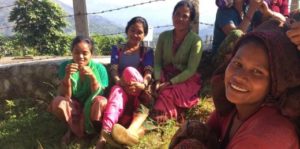
Photo: Nikolina Stålhand / IM
Although the earthquake affected many around Nepal, the devastation was worst in the Gorkha area - an area in the mountains that even before the earthquake was mainly populated by poor farmers. Homes were destroyed, schools were closed, people were injured, died and life investments were lost. A teacher at a school in the area tells how he and his colleagues had a planning meeting when everything suddenly started to shake. He managed to survive even though he is still afraid of loud noises and has memory problems after being hit in the head by a boulder. It was worse for three of his colleagues who lost their lives.
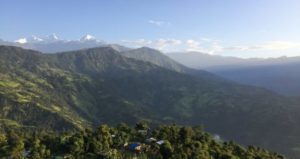
Photo: Nikolina Stålhand / IM
Despite the fact that more than two years have passed since the earthquake occurred, much reconstruction still remains. People live in temporary houses with walls built of sheet metal. Schools are under construction and a lot of equipment is missing. It may seem like a hopeless situation, but after my field visit to the area, what I take with me is the exact opposite - a belief in the future and a fighting spirit beyond the ordinary.
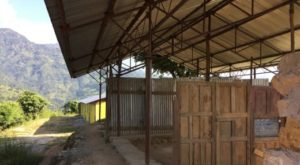
Photo: Nikolina Stålhand / IM
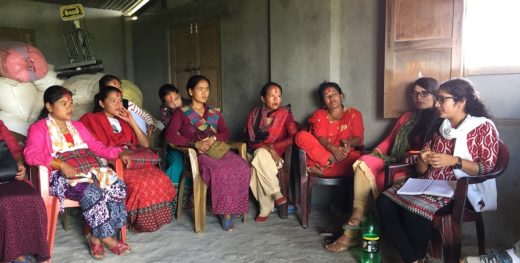
With financial support from Individual Humanitarian Aid, MADE-Nepal runs several projects to improve the situation for marginalized groups in the area. Common to several projects is a focus on help for self-help - to educate and provide tools to people in different ways to improve their situation in a long-term and sustainable way. During my field visit, I saw several examples of this. In one project, women from the marginalized group Janjati have been trained to learn how to create Dhaka clothes, which are then sold and thus create an income for their families. Sneha Gurung, 24, talks about how, after completing her education, she wants to continue creating clothes in order to become financially independent and be able to improve life for herself and her family. Above all, Sneha dreams of being able to earn money to give her four-year-old son a good education in the future.
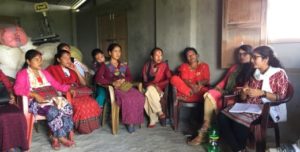
Photo: Nikolina Stålhand / IM
In another project, marginalized farmers, mainly Dalit women, have undergone training in how to raise and care for goats. Seti Nepali proudly says that through his education, he has learned how to grow fodder, the importance of sanitation and how to build a good home for goats. He says that the education has given him increased self-confidence to invest in goat breeding in order to improve the life situation for his entire family. In the future, the plan is for the breeding of goats to be commercialized and thus provide an increased income. Fulmaya, Parbati, Sunita and Januka, who also participated in the training, say that their hope is that, through increased income, they will be able to buy school materials and send their children to good schools.
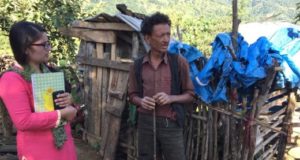
Photo: Nikolina Stålhand / IM
Even though life for the people of Gorkha is not the same as before April 25, 2015, life goes on. In temporary houses built of sheet metal but with a will and belief in a bright future.